What Is Borosilicate Glass And Why Does It Matter For Your Drinkware
Key Takeways
- Borosilicate glass contains boron trioxide, making it far more resistant to thermal shock than regular soda-lime glass.
- It is chemically inert — no compounds leach into your beverages regardless of temperature or acidity.
- Every Kikiluxxa product — from 140ml espresso mugs to 1.9L water jugs — is made from premium borosilicate glass.
- Maintains crystal clarity over time, is microwave safe (lid removed), and top-rack dishwasher safe.
- Choosing borosilicate is a long-term investment — less waste, fewer replacements, and a better daily experience.
Introduction
You’ve probably seen the term ‘borosilicate glass’ on product listings and wondered whether it actually makes a difference. The short answer is yes — significantly. At Kikiluxxa, every jug, mug, tumbler, and teapot is made from premium borosilicate glass. Here’s the full story on why that matters.
Most people pick up a glass without a second thought. But the material your drinkware is made from affects everything — how it handles heat, how long it lasts, whether it leaches chemicals into your morning coffee, and even how clear and beautiful it looks five years from now. Understanding borosilicate glass is the first step to understanding why Kikiluxxa products are built differently.
What Exactly Is Borosilicate Glass?
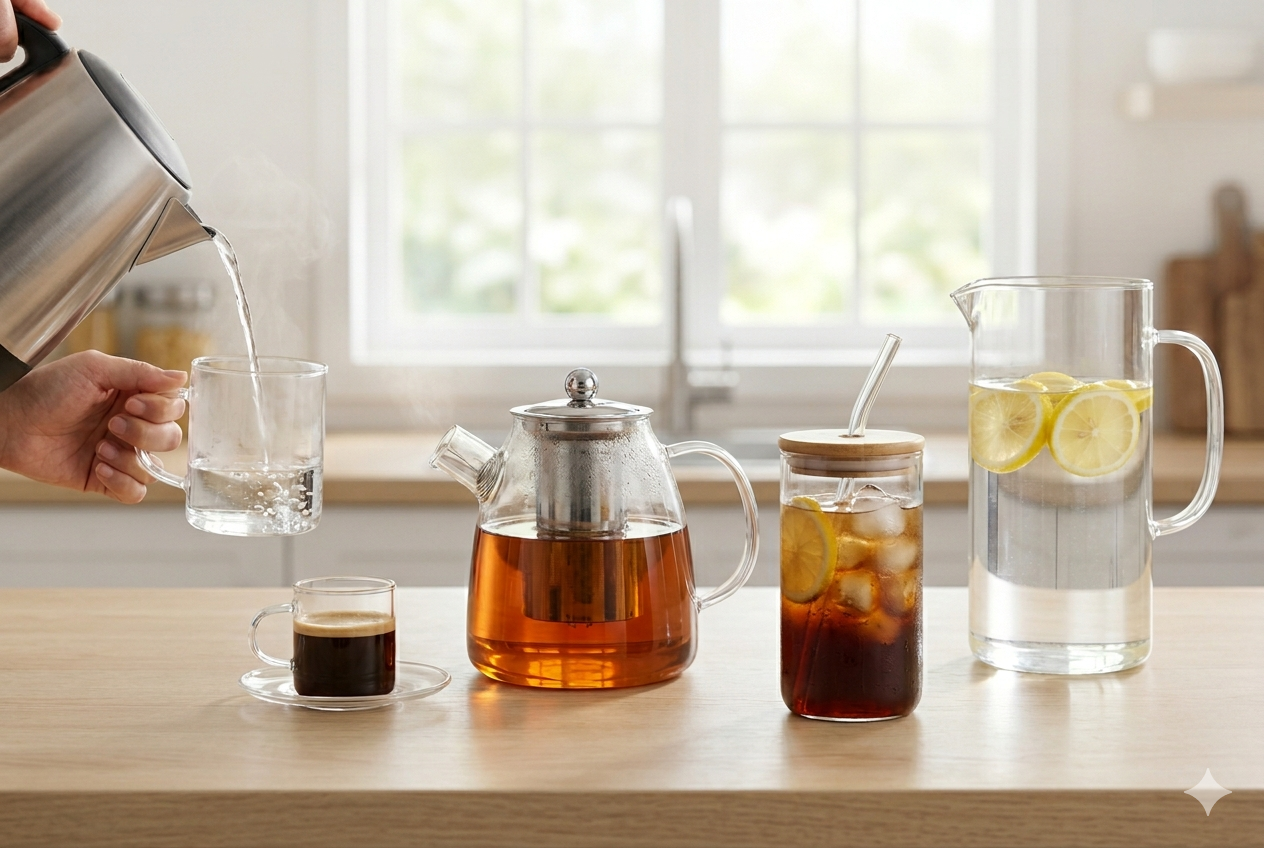
Borosilicate glass is made by adding boron trioxide to the standard silica-and-soda mixture used in regular glass. This changes the molecular structure, making it significantly more resistant to thermal shock — the cracking that occurs when glass rapidly changes temperature. The result is a glass that can handle boiling tea poured directly in, or a freezer-to-table moment, without shattering.
A Brief History
Borosilicate glass was first developed in the late 19th century by German glassmaker Otto Schott. It quickly became the industry standard for scientific laboratory equipment, pharmaceutical containers, and high-quality cookware worldwide. Its use in everyday drinkware is a relatively recent shift — and a genuinely meaningful upgrade for anyone who cares about what they drink from.
What Makes It Molecularly Different
The addition of boron trioxide creates a three-dimensional network structure in the glass that is far more stable under stress. This is not a surface coating or treatment — it is built into the material itself from the moment it is formed. That is why the performance does not wear off over time.
How It Differs From Regular Soda-Lime Glass
Regular soda-lime glass expands and contracts dramatically with temperature changes. Borosilicate glass has a much lower coefficient of thermal expansion — it barely reacts to heat or cold. This is why laboratory equipment has always been made from it.
What Is Soda-Lime Glass?
Soda-lime glass is the most common type of glass in the world. It is used in windows, cheap drinkware, and most mass-market kitchen products. It is inexpensive to produce but reacts poorly to temperature changes and can leach small amounts of compounds into acidic or hot liquids over time.
Side-By-Side Comparison
| Feature | Borosilicate Glass | Soda-Lime Glass |
|---|---|---|
| Thermal Expansion | Expands at roughly one third the rate of soda-lime glass. Almost zero stress when hot liquid meets cold glass or vice versa. | Expands and contracts dramatically with temperature changes. High risk of cracking under rapid heat shifts. |
| Chemical Resistance | Highly resistant to most acids, alkalis, and organic solvents. Safe for all beverage types at any temperature. | Moderately resistant only. Can degrade and leach compounds with repeated exposure to acidic or hot liquids. |
| Optical Clarity Over Time | Manufactured with tight purity controls. No green tint, no cloudiness — stays crystal clear even after years of daily washing. | Contains iron impurities that create a faint green tint, especially visible at the edges. Clarity fades over time. |
| Durability Under Daily Use | Handles everyday knocks, temperature cycles, and repeated washing significantly better. Considerably more forgiving in a busy household. | More prone to chipping, cracking, and surface wear under the same daily conditions. Less resilient over time. |
| Long-Term Value | Higher upfront cost. Needs replacing far less often — the more economical choice over a two to three year period. | Lower upfront cost. Breaks and needs replacement more frequently — more expensive in the long run. |
Key Benefits At A Glance
- Thermal shock resistance — handles rapid hot-to-cold transitions without cracking or shattering
- Chemical inertness — zero leaching into beverages, even with acidic drinks like lemon water or tomato juice
- Exceptional optical clarity — no green tint or cloudiness over time, even after hundreds of washes
- Microwave safe (lid removed) — reheat your coffee or tea without transferring to another vessel
- Dishwasher safe (top rack) — hand washing is preferred for longevity, especially for pieces with bamboo or silicone lids
- Taste-neutral — glass does not absorb flavours or odours, so every drink tastes exactly as it should
Why Kikiluxxa Uses Borosilicate Glass Exclusively
We chose borosilicate as our foundation material because it aligns with our philosophy of making products that outlast trends. Cheap soda-lime glass breaks quickly, ends up in landfill, and needs replacement. Our pieces are built to become part of your daily routine for years — from our 140ml espresso mugs to our 1.9L water jugs.
The Sustainability Reason
Every borosilicate piece that stays in use for three or four years instead of breaking in six months is one fewer item entering the waste stream. Glass is also fully recyclable at end of life and does not shed microplastics the way plastic drinkware does. Choosing borosilicate is a small but genuine environmental decision.
The Aesthetic Reason
Borosilicate glass has a natural clarity and lightness to it that simply looks better. When you pour a cold-brew coffee into a clear borosilicate tumbler and the layers settle visually — that is not an accident. The material makes the moment. Cheaper glass cannot replicate that quality of light and transparency.
The Longevity Reason
We are not interested in making products people replace every year. Every Kikiluxxa piece is designed to earn a permanent place in your daily routine. Borosilicate is the only material that supports that ambition honestly.
The Science Behind Thermal Shock Resistance
Thermal shock occurs when different parts of a material expand or contract at different rates simultaneously. In standard glass, this uneven stress creates microscopic fractures that travel rapidly through the material — causing the glass to crack or shatter.
Borosilicate glass has a coefficient of thermal expansion (CTE) of approximately 3.3 × 10⁻⁶/°C — roughly one third of soda-lime glass. In plain language: when you pour boiling water into it, the entire glass expands so uniformly and minimally that no stress fractures form.
For everyday drinkware, this means you can take a Kikiluxxa mug from a cold cupboard, pour freshly boiled tea into it, and not give it a second thought. That’s the kind of quiet reliability that changes your daily routine for the better.
Borosilicate Glass And Food Safety
One of the less-discussed benefits of borosilicate glass is its food safety profile. Unlike certain plastics or lower-grade glass, borosilicate does not leach chemicals into your drink. This matters most with:
- Hot acidic drinks — black coffee, lemon tea, citrus juices — compounds that could cause leaching from inferior materials
- Long-steeping teas — where hot liquid is in contact with the vessel for extended periods
- Overnight infusions — fruit water or cold brews left in the fridge for hours
With borosilicate, the glass surface is essentially impermeable and chemically stable. What goes in tastes exactly as it should — nothing more, nothing less.
Which Kikiluxxa Products Use Borosilicate Glass?
Every single product in the Kikiluxxa range is made from premium borosilicate glass — no exceptions.
- Glass mugs — 140ml espresso size through to 350ml and 450ml larger mugs, all handle-equipped for hot drinks
- Tumblers — multiple sizes with lids and straws, suitable for cold brew, iced tea, smoothies, and water
- Teapots — with integrated infusers, allowing you to watch your tea bloom inside clear borosilicate glass
- Water jugs — 1.5L and 1.9L options for table serving, with the same thermal resilience and clarity
Care Tips To Get The Most From Your Borosilicate Glassware
Borosilicate glass is durable, but it still deserves thoughtful handling. Follow these simple guidelines to extend the life of your Kikiluxxa pieces:
- Avoid sudden surface changes — do not place a hot glass directly onto a very cold stone or metal surface. A wooden board or cloth in between is ideal.
- Hand wash for longevity — mild soap and a soft sponge is all you need. The dishwasher is technically safe on the top rack, but repeated high-heat cycles over years can dull the finish of any glass.
- Microwave without metal or bamboo — always remove lids before microwaving. The glass body is fine; the accessories are not.
- Store upright — stacking glasses upside-down on rims is the most common cause of rim chipping over time.
- Avoid abrasive tools — steel wool or harsh scrubbers can scratch the surface. A soft cloth or silicone sponge keeps the glass looking new.
FAQs
1. Is Borosilicate Glass Completely Shatterproof?
No glass is truly shatterproof. Borosilicate is significantly more resistant to thermal shock and general stress than soda-lime glass, but it can still break if dropped from height onto a hard floor. What it will not do is crack from hot liquids, rapid temperature changes, or normal daily use.
2. Can I Pour Boiling Water Directly Into A Kikiluxxa Glass?
Yes. Borosilicate glass is designed for exactly this. You can pour water straight off the boil into any Kikiluxxa mug, teapot, or jug without any risk of thermal cracking.
3. Does Borosilicate Glass Affect The Taste Of Drinks?
Not at all — and that is one of its key advantages. Glass is taste-neutral. It does not absorb or impart flavours the way plastic can, and it does not affect aroma. Your tea tastes like tea; your coffee tastes like coffee.
4. How Do I Know If Glass Is Genuinely Borosilicate?
Reputable brands will specify it clearly on the product page and packaging. Genuine borosilicate has a subtly different feel — slightly lighter and with a particular clarity. At Kikiluxxa, every product description specifies premium borosilicate glass, and we stand behind that claim.
5. Is Borosilicate Glass More Environmentally Friendly Than Plastic?
Yes, in terms of long-term impact. A single borosilicate glass used for three to five years produces significantly less waste than multiple plastic bottles replaced over the same period. Glass is also fully recyclable at end of life and does not break down into microplastics.
Tags:
- Borosilicate Glass, Premium Glass Drinkware
Related Posts
Most people know they should drink more water. The advice is everywhere — eight glasses a day, half your body...
- 6 min read

- 6 min read

- 6 min read
- 6 min read